
The Beginning
Tom Keating is a singer, songwriter and producer of sorts, but, more than any of that, Tom is a storyteller and a performer.
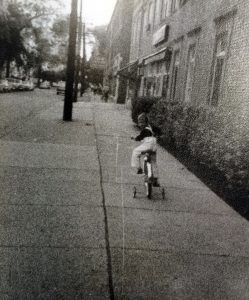 The life cycle of Tom’s music is Godzilla like – dormant through years of quiet longing and premeditation – only to at last spring from the darkness of studio, dusty songbooks and caverns of dreams dying – to roar in rare moments across the sonic span. Tom’s road less traveled traverses coffee houses, your neighbor’s yard, high energy bar performances and any place he can find soaked in sweat, love and the joy of anthemic connection.
There is a yearning in the drone of the working life, the slam of a head in a locker, the sounds of mournful factory whistles and death knell school bells. This music is about trying to get out by way of the radio, the life-giving pulse of rock n roll and motor city soul.
For Tom Detroit blowtorches WJLB, WKNR and of course – the Big 8 CKLW! – were the holy grail. “This music had a refuge and an energy I could feel deep inside….but at first, there was no worldly connection to it…only cinematic images, belief and longing, only admiration for kids I knew who came from some sort of place where they had somebody or something that helped them make all those wonderful sounds tactile and tangible – at first I didn’t have that…”
Still, in the radio Tom had found a trusted friend, partner and ultimately – savior. As a kid he worked in an east side factory that righteously soaked him in the sweat of the beat – sounds borne of the irresistible pulse of Martha Jean the Queen of soul, boogying on down the production line in grease heat, the backline supported by relentless waves of pneumatic blast. This was a place of tar stains, grease barrels and benediction made pure by the greatest music ever known, music that for Tom was impossibly springing from right down the street.
Days in school, nervously tapping his finger on the table to the all-time hits always playing in his head, Tom sought only to be delivered. Delivered please, oh lord, from the drone of Dullsville, to the place of sanctification on that radio. In a moment of ambition, he picked up a cast-off yard sale guitar long enough to teach himself 3 chords. “Like the man said – the first time I looked in the mirror and could stand what I was seeing – I had a guitar in my hand…”
The Banned
Tom soon enlisted a few other outcasts – Jim Osborn (current location unknown) Billy Franz (LA or some stuff) and David Witte (Rocket Scientist) to form The Banned, a four piece fledgling rock ‘n’ roll band low on skill but very high on energy and belief that improbably gained enough momentum to play with some of the great Ann Arbor groups of that period including the Mutants, Ragnar Kvaran, the Infidels, the State, and Nikki and the Corvettes.
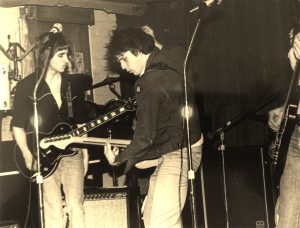
A fixture at the shows of other great bands of that time and place including the Sonics Rendezvous Band, the Cult Heros, The Replacements, and the Ramones – Tom even got the Romantics to play a gig at his school lunchroom – a gig he himself played the next year. “I just thought everybody had great bands like that playing at the end of their street all the time” Tom said… “now I know I was really, really lucky”.
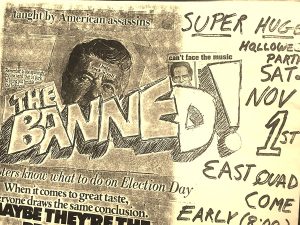 In all this, Tom earned his “front man” cub scout merit badge playing at bars, house parties, high school and college functions while fronting The Banned’s high energy, anarchic delivery. But being raised on radio, Tom remains to this day joyous on either side of the stage – his gig, your gig. Our sanctuary.
There is a certain phylogeny of rock n roll bands. They are unstable atoms, most times really, really, unstable. So as the Banned waved goodbye at the station with a kiss, a tear and a wish for something better than the huge thing everybody was giving up, Tom resolved to write and record on a consistent basis forever or at least until closing time. Here again came an unlikely catalyst.
Recording Roots
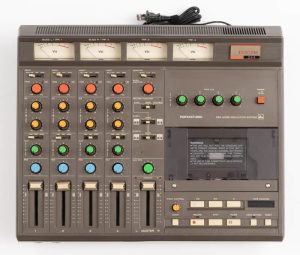
The now obsolete technology of the Tascam cassette four track porta studio allowed a refuge where Tom would write, play, record and begin to craft production of his own materials, much of which early on had been written for the Banned. As the tracks generated year after year, the cassettes were kept in an old wood Box that accumulated dust but remained vital as the eras of punk, disco, MTV, hair bands, grunge and all the rest came and went.
Life moves on, as moving on will. In and out of The Box, Tom has written or recorded hundreds of works, some of which survived to find their way onto later day professional re-recordings. Tom is endlessly thankful to the late Detroit producer/musician Chuck Miller (Holy Smoke) who transported much of Tom’s 4 track tape work from the 80s and 90s into the digital age.
Hanging around – after work one day in the early 2000s Tom went to see an old friend – blues/jazz great RJ Spangler at a gig….. “RJ said ‘Tom – looks like you still got the itch!’ And I did, man, I really, really did…” So, RJ introduced Tom to blues guitar maestros Jimmy Alter and Carlton Washington, who invited him to their gigs… “At first, for like a year or two I’d watch all these really talented blues cats – wondering how could a punker like me do that…eventually I took the plunge though… I started playing out again just expecting to be like..ya know …the third guitarist at a local jam…I just wanted to be on that stage for a second, if only in the back row…”
But that was not to be. Tom is and always has been a performer, a rough diamond of fanatic joy, misplaced someplace in the golden age of rock ‘n soul – just now finally unearthed, polished, clean and cutting like a Motor City cold saw blade. Third position guitar didn’t last for long. Almost immediately he was jumping off tables and begging the audience please, please, please….because really, that’s who he’d been all along.
From that, “Tommy Adderall”, as he’s often called out by bandmates and friends, has become a fixture on the jam, solo and gig circuit. There are shows all summer every summer at the local joints, shoreline gigs and occasional Detroit Blues Society keynote events.
Still, most treasured by Tom, and captured in his work, are the music shrines of Detroit’s East Side – some here, some gone – the Cadieux Café, the Blue Goose, Detroit’s High Noon Saloon and the (awesome!) First Place Lounge, places of community and musical redemption that have hugely impacted and nurtured Tom’s own music. These are places of rising, places of proclamation, faith and the power of the renegade beat, blasting out of rubble and into an ether born of the shake, a rattle and roll brewed in alley cinder and torrid tunnels of life-giving Detroit steam.
There lies in this music the lonesome hearted soul of a Jefferson Avenue – the bastard son of the industrial age, revived in the sanctuary of a precious and cherished music community, a rendering of tears, joy, love and grace.
Tom has been supremely privileged play alongside many of the greatest Detroit musicians of recent history, including Joey Spina (Uncle Kracker, Whitey Morgan and the 97s), the late and great Paul Carey (Sun Messengers, Mack Rice), Carlton Washington (Thornetta Davis), R.J. Spangler (Sun Messengers, Planet D. Nonet), Jimmy Alter (Tosha Owens and the Stable dudes) Brendon Lindsley, Martin Chaparro (MC3, Low Key) the legendary and most beautifully remembered Detroit beatmaster and MC, the late great David Watson (I miss you every day), Niko Eklund and the Highballs, Reed Knight and Cap Gun, Chris Putt, RAYMONE!, Erich Goebel (Erich Goebel and the Flying Crowbars)…. In these great artists and friends, and the community, love and support they have fostered, Tom has found inspiration, encouragement and support without which the music you will find here could never have been remotely possible.
Most recently, Tom has worked with legendary garage rock producer Jim Diamond, also of the Sonics and the Dirtbombs, and Eddie Baranek of the Sights in their co-produced recent release, a musical exploration of life, death, near misses and all-time hits – all framed in the toil and redemption of the streets, bars and neighborhoods of Jefferson Avenue, the lifeline of Detroit’s East Side.